A Monochrome Orchestra: The Illusion of Touch

If you ask a violinist or a singer what their greatest challenge is, they will likely say: finding the pitch. They must physically build every single note out of thin air, muscle memory, and pure air pressure.

The pianist, on the other hand, has it easy. You sit down, you press a key, and—voilà!—the note is already perfectly formed, tuned, and ready to go. On paper, the piano is one of the most democratic instruments in the world. Anyone can press middle C and produce the exact same acoustic pitch as a concert grandmaster.

And yet, if that were the whole story, why does the same Steinway sound like a thunderous wall of brass under one person’s fingers, and like cascading liquid silk under another’s? Welcome to the ultimate mystery of the eighty-eight keys: the illusion of touch.

What’s in a Name? The Soft-Loud Revolution

To understand the magic of touch, we have to look back at the instrument’s birth. Around the turn of the 18th century, a genius harpsichord maker in Florence named Bartolomeo Cristofori got frustrated. The harpsichord, while beautiful, was a mechanical mono-level beast: no matter how hard or soft you plucked the string, the volume remained stubbornly the same.

Cristofori’s revolutionary invention was a system of leather-covered hammers that struck the strings instead of plucking them. He called his creation the gravicembalo col piano e forte—literally, the “harpsichord with soft and loud.”

Eventually shortened to just pianoforte, and then piano, the name itself was a declaration of freedom. For the first time, a keyboard player’s physical pressure was directly translated into raw, dynamic emotion.

The Great Paradox: Lever, Felt, and Wood

Scientifically speaking, once a piano hammer is released and flies toward the string, the pianist has lost all control. You cannot vibrato a note on a piano like you can on a cello. You cannot swell the sound after the key is struck. Physically, the piano is a percussion instrument—a box of wood, felt, and iron.

Yet, a master pianist can make those hammer strikes sound like woodwinds, human voices, or a watercolor painting. This is the alchemy of “touch” (il tocco). It is a combination of release speed, the weight of the arm, the subtle friction of the fingertip sliding on the key, and the micro-miliseconds of space between notes.

The piano has only black and white keys, but in the hands of a poet, it holds an infinite palette of colors.

Legends of the Touch: Fire, Silk, and Surgical Precision

Throughout history, the obsession with touch has defined the world’s greatest pianists.

Take Vladimir Horowitz, the legend of romantic pianism. He was famous for playing with almost completely flat fingers—a technique that would make any traditional piano teacher scream in horror. Yet, this flat-finger approach allowed him to coax a massive, orchestral depth out of the keys without ever sounding harsh or “banging.” He could make a single, quiet melody in a Mozart sonata carry to the very back row of Carnegie Hall, shimmering like spun gold.

Then, there was Arturo Benedetti Michelangeli, the high priest of tone color. Michelangeli’s obsession with the piano’s touch and action was legendary. He treated his Steinway like a high-strung child or a precise scientific instrument, once famously claiming that “three notes with the right pedal work can become another world.” His fingers had an almost supernatural ability to mold the musical texture like melted wax, leaving audiences wondering how a percussion instrument could sound so breathtakingly fluid.

The Invisible Bridge

Ultimately, touch is the invisible bridge between the physics of the piano and the imagination of the musician. It is the reason why a machine can play a MIDI file with mathematical perfection, but it will still sound cold and lifeless compared to a human being who knows how to make the keys breathe.

When you listen to a pianist who has mastered this illusion, you aren’t just hearing hammers hitting strings. You are watching someone paint with sound, proving that even in a world of black and white, there are infinite colors waiting to be discovered.
A Monochrome Orchestra: The Art of the Piano Transcription

Imagine holding an entire eighty-piece symphony orchestra in the palm of your hand—or rather, within the tips of your ten fingers. Long before digital streaming, high-fidelity vinyl, or even the crackle of the early phonograph, there was only one way to bring the grandeur of Beethoven’s Ninth or the drama of Verdi’s latest opera into a local salon: the piano transcription. It was the ultimate musical shape-shifter, translating a kaleidoscope of brass, woodwinds, and strings into the stark, brilliant architecture of eighty-eight black and white keys.

The Great Translation: From Concert Hall to Keyboard

In the nineteenth century, piano transcriptions were essentially the “Spotify” of their era. Franz Liszt, the undisputed rockstar of the romantic keyboard, famously transcribed all of Beethoven’s symphonies. His goal wasn’t just to copy the notes, but to replicate the illusion of orchestral mass. When playing these arrangements, the pianist isn’t just an instrumentalist; they are a conductor wrestling with a self-contained wooden cosmos, using the sustaining pedal to mimic a wall of violins, and a sharp staccato to evoke the bite of a pizzicato cello.

From the sweeping narratives of operatic paraphrases to the rhythmic precision needed for ballet scores, transcriptions proved that the piano could mimic almost any texture. But it required a unique kind of wizardry: the ability to prioritize. A pianist cannot physically play every single note an orchestra produces. The art lies in choosing the exact notes that preserve the dramatic tension and the fundamental heartbeat of the piece.

The Maestro Collaborator: The Alchemist of the Rehearsal Hall

This historical legacy comes alive every single day in opera houses and ballet companies through the figure of the maestro collaboratore, or rehearsal pianist. If the stage is a canvas, the pianist is the one sketching the precise, indelible outline before the paint is applied.

An exceptional rehearsal pianist doesn’t just play a reduction of the score; they perform a nightly act of musical telepathy. They must evoke a solo oboe during a delicate ballet variation, or punch out the brass accents in a dramatic operatic finale, all while keeping their eyes glued to the stage, navigating the caprices of a guest conductor or the sudden, breathless pacing of a prima ballerina.

“A great rehearsal pianist doesn’t just play the notes on the page; they play the intent of the instruments. They make eighty-eight keys sound like a hundred musicians breathing together

Chasing the Ghost of the Orchestra: Legends of the Pit

The history of music is packed with legendary figures who started or excelled in this exact crucible. A young Richard Strauss worked extensively as a repetitive coach, famously reducing the most complex Wagnerian orchestral scores at sight, making the piano sound like a roaring wall of brass.

There is a famous anecdote involving the legendary, notoriously demanding conductor Arturo Toscanini and a rehearsal pianist at La Scala. During a chaotic opera rehearsal, the singers completely lost their place, drifting into a rhythmic panic. Without missing a beat, the pianist seamlessly modified the accompaniment on the spot—transposing a passage up a semitone and shifting the rhythm to perfectly catch the failing soprano, steering the entire ensemble back to safety. Toscanini stopped the orchestra, glared at the stage, then looked down at the pit and barked:

“You! You are the only one here who actually understands the architecture of this opera. Everyone else is just making noise!”

In the ballet world, the demands are equally legendary. Igor Stravinsky’s Petrushka or Tchaikovsky’s The Sleeping Beauty feature rhythms so intricate that a single misplaced accent can ruin a dancer’s leap. The pianist in the studio is the safety net, the metronome, and the emotional guide all at once.

The Symphony Lives On

When you listen to a public performance where a pianist handles an orchestral score, you are witnessing an ancient, noble craft. It is a tightrope walk without a net. The next time you hear a piano mimic the swell of a horn section, or the cascading runs of a harp, remember that you aren’t just listening to a keyboard instrument. You are listening to a brilliant, monochrome illusion—a single human being conducting an invisible orchestra, captured beautifully in black and white

Intelligenza artificiale e composizione musicale

Ringrazio Marco Ignoti e Riccardo Acciarino per aver dato vita a Tardemà per clarinetto basso, clarinetto in Mib e Tape.

Martedì 11 ottobre 2022 alle ore 20.30 al Pacta Salone di Milano si è svolto il concerto Digital Humanity con il Syntax Ensemble.
In scena pagine musicali ai limiti della creatività grafica e concettuale, ma anche incontri: tra il nascondere e il mostrare, tra l’elettronico e l’acustico, tra il tape e il live-electronics, tra lo strumentista e il sound designer. Un programma d’impatto sonoro e ideologico in cui il pubblico può scoprire Sabre, il multisensore innovativo che si pone l’obiettivo di conferire umanità interpretativa al suono digitale.
Milano

La prima parte, acustica, prevede musiche di Dolphy, Kagel e Steffens; la seconda parte, elettro-acustica, è dedicata a brani di Müller, Benetti e Pivetti.

Su Raiplay

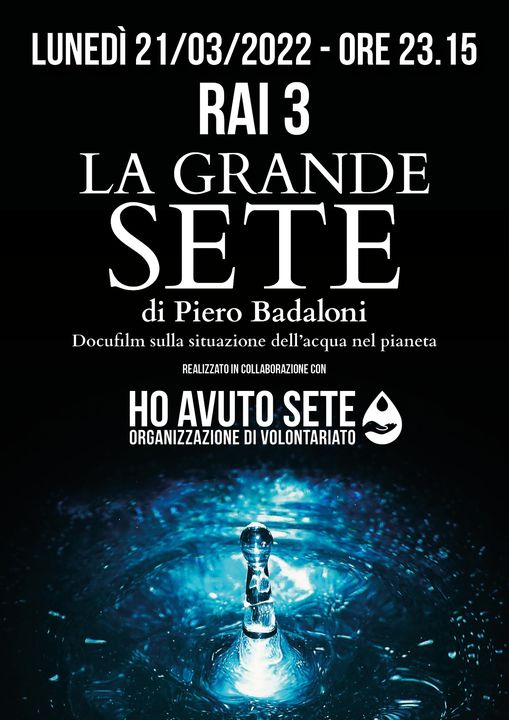
Negli ultimi cento anni il consumo di acqua nel mondo è aumentato vertiginosamente, ma per gran parte della popolazione dei paesi più poveri l’accesso all’acqua potabile è ancora un miraggio. Ed il rischio che nascano guerre fra Stati per accaparrarsi questo bene prezioso è sempre molto grande. Il documentario di Piero Badaloni analizza questo problema globale mettendo in evidenza i dati dell’attuale uso e consumo di acqua, il ruolo dell’Italia e degli altri stati mondiali, il problema del degrado e dell’inquinamento idrico e il divario crescente tra Nord e Sud del mondo. In collaborazione con l’organizzazione di volontariato “Ho avuto sete”.

Clicca qui per vedere il docufilm su raiplay

La grande sete

Original soundtrack disponibile sulle principali piattaforme

Per celebrare la Giornata mondiale dell’acqua, istituita dalle Nazioni Unite, lunedì 21 marzo alle 23.15 andrà in onda su Rai 3 La Grande Sete di Piero Badaloni, prodotto da Land Comunicazioni in collaborazione con l’organizzazione di volontariato “Ho avuto sete”. Negli ultimi cento anni il consumo dell’acqua è aumentato di sei volte nel mondo occidentale, ma non nei paesi più poveri, dove l’accesso all’acqua è diventato sempre più un miraggio. Per questo nel 2015 l’ONU ha fatto approvare e firmare dai paesi membri un’agenda con indicati una serie di obiettivi da raggiungere entro il 2030 per arrivare a uno sviluppo sostenibile che non lasci indietro nessuno. Tra gli obiettivi più ambiziosi:  la riduzione della disuguaglianza nell’accesso all’acqua. Nel nord se ne consuma e se ne spreca troppa, anche per l’inquinamento delle fonti idriche; nel sud si rischia di arrivare a guerre fra Stati per assicurarsi quel poco che ne è rimasto. Cosa si sta facendo per evitare catastrofi? Cominciamo con il frenare i danni dei cambiamenti climatici, suggerisce Antonello Pasini, fisico del CNR. Lavoriamo per una gestione integrata delle dighe nei grandi bacini interstatali, propone Stefania Giannini, vicedirettrice generale dell’UNESCO. Ma soprattutto evitiamo che l’acqua diventi un bene finanziario, lancia l’allarme padre Alex Zanotelli, un missionario che di Africa se ne intende.

(10 minutes) Passio

Ecco la sfida: in dieci minuti di musica raccontare in forma condensatissima alcuni dei sentimenti maggiori che scorrono nel racconto dei racconti, la Passione di Gesù Cristo. Dieci minuti di musica con la pretesa che l’ascolto sia vero, reale, non un sottofondo ad altre attività. Dieci minuti di musica perché ognuno di noi ha già tanta esperienza di cosa siano l’amicizia, la gratuità, l’amore, la paura, il perdono, la fiducia. Ecco il gioco: dieci minuti di solo ascolto, senza fare altro, per lasciare emergere dalla nostra vita questi sentimenti e metterli in relazione con i sentimenti che furono di Gesù. Se non funzionerà, se non vi sarà piaciuto. Se sarà d’aiuto sarò felice: un piccolissimo contributo alla semina della pace in tutti noi.

Potete trovare i 4 brani di (Ten minutes) Passio sulle principali piattaforme o gratuitamente su youtube.

(10 minutes) Passio

(Grazie a Luca per la splendida foto dai ghiacciai canadesi!)

A le segrete cose

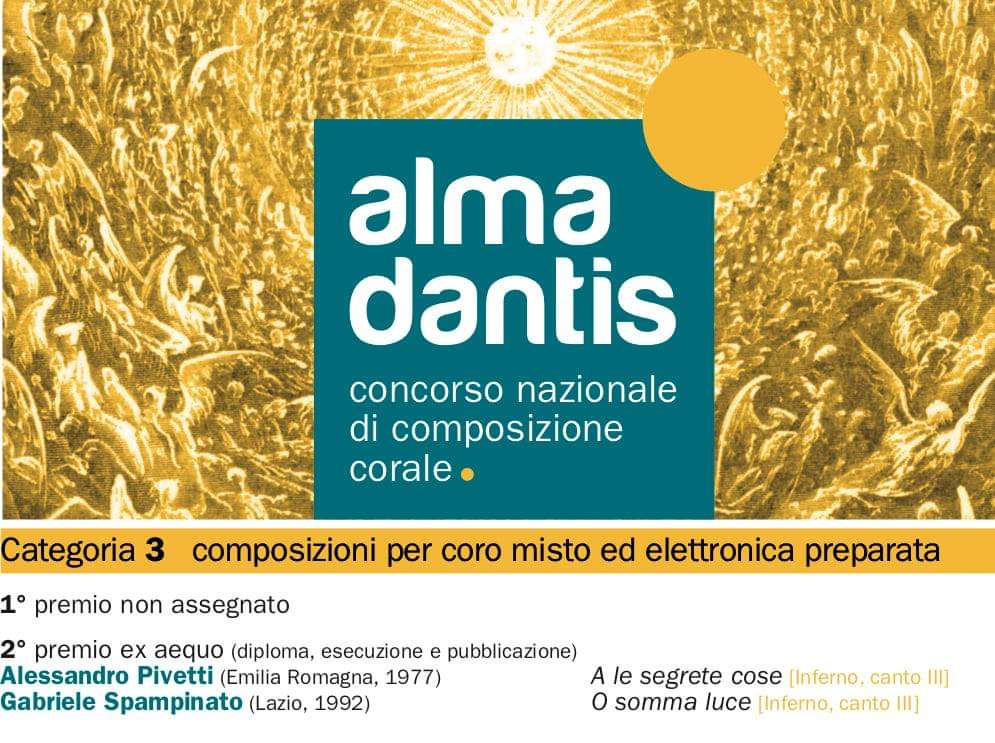
Condivido un’importante soddisfazione personale: il mio pezzo per coro “A le segrete cose”, su testo di Dante Alighieri, è arrivato secondo ex aequo al concorso nazionale Alma Dantis (Feniarco, Siae, Ministero della Cultura, Società Italiana di Musica Contemporanea, Società Dantesca Italiana) e sarà eseguito, in prima assoluta, in un pubblico concerto presso l’Auditorium Parco della Musica di Roma. Un grazie sentito al mio maestro Paolo Aralla che, oltre ad avermi insegnato che la musica si scrive con la gomma e non con la matita, mi ha avviato alle gioie e ai dolori di Max-Msp e all’elettronica musicale. Grazie a chi mi ha sostenuto da sempre nel percorso musicale, famigliari, amici e insegnanti, alla commissione del concorso e al Coro Giovanile Italiano che eseguirà “A le segrete cose”.

Confidando in un periodo di miglioramento generale per tutti, per Carpi, per il nostro paese… mi auguro che l’arte possa sostenere anche solo un po’ la guarigione di tante sofferenze nascoste, mi auguro che il nostro lavoro di artisti possa aiutare a immaginare qualcosa di nuovo. Tornare a come era prima è inutile a questo punto. Chi ha voglia di futuro lo sa bene…

Un Podcast per riappropriarsi degli spazi urbani

Reggiolo in cuffia è una guida multimediale del paese di Reggiolo e la puoi ascoltare, guardare e toccare gratuitamente scaricando l’applicazione “Izi Travel” sul tuo smartphone, o ascoltare come un podcast ovunque ti trovi.
Giovanni ti accompagnerà  in questo percorso sonoro di 17 tappe e grazie all’aiuto delle persone che incontrerà lungo il cammino, ti racconterà i luoghi nei quali vive con la curiosità e lo stupore di quando ci si accorge che nel proprio giardino è sbocciato un fiore nuovo. Seguilo e preparati a scoprire il suono, la voce e l’essenza di Reggiolo.

In Reggiolo in cuffia hanno interpretato loro stessi Anna Battini, Fulvio Casella, Giovanni Fava, Alberto Ferraresi, Vittorio Piva, Maria Puglia, Roberto Rinaldi, Elena Storchi, Adelmo Torelli, Maurizio Torreggiani e i ragazzi del muretto.
Sono anche intervenuti Anna Aldrovandi, Silvia Ancelotti, Nicola Costa, Augusto Troni. Per i restanti suoni, rumori e voci ai quali non siamo riusciti a dare un nome e che amabilmente ringraziamo, lasciamo a voi la libertà di immaginarne le sorgenti.

Le musiche sono state composte da Alessandro Pivetti e eseguite da  Devis Ferrari, Cristina Lasagna, Marcella Marmiroli, Deborah Sironi, Matteo Vaccari e Alessandro Zanoli.

Le fotografie sono state scattate dai membri Circolo Pixel Reggiolo guidati da Vanni Borghi che ha curato il laboratorio “Saluti da Reggiolo”.

Le forme (digitali, su carta e Corten) sono state disegnate da Elisabetta Spaggiari. La segnaletica di RIC è stata ideata in collaborazione con Martina Magnani e realizzata da Officine Falavigna Spa.

La cura, la regia e il montaggio sono di Giovanni Fava con il prezioso supporto di Laura Pazzola, Elisabetta Spaggiari e Jonathan Zenti.

RIC è un progetto di Deus ASD vincitore del bando GPT sostenuto da Regione Emilia Romagna, IBC, Comune di Reggiolo, Pro loco, Impresa edile GMP e divenuto realtà grazie alla partecipazione di Anna Aldrovandi, Pietro Bertazzoni, Antonio De Monaco, Ludovica De Monaco, Marianna Facchini, Giorgia Leardini, Martina Magnani, Alice Petocchi, Ilaria Piccagli.

Un sentito grazie a Marco Musi e Deus Staff, circolo musicale G. Rinaldi, Officine Falavigna, associazione parco dei salici, Centro sociale “Nino Za” e ai tanti che con entusiasmo incondizionato si sono prestati per realizzare questo progetto.

E’ per merito di queste persone se l’idea di RIC si è trasformata in qualcosa di reale e condiviso che appartiene a tutti.

Double Exposure – Gianni Vancini and Alessandro Pivetti

A duo concert to rediscover an instrument and his repertoire – the saxophone – always present in both worlds, classical and jazz. Great composers that were able to combine two different worlds that could seem different, but only in surface. Saxophone mixed with the piano, for a classical and jazz meeting. A music journey long more than a century, going from Paul Bonneau, Phil Woods and Astor Piazzola, to some original pieces from Pivetti and Vancini.